
Yes. But not the way most contractors think.
You tried ChatGPT for SEO. You got an article back in 60 seconds. It looked complete, so you published it.
Now it is not ranking. And if you keep doing that, your site will not rank either.
ChatGPT can do parts of SEO: drafting content, brainstorming topics, writing meta descriptions, and suggesting structure. It cannot do local SEO on its own. It does not know your market, your customers, or your city. Without human input, AI content is generic, and generic does not rank locally.
Here is exactly where AI helps, where it fails, and what actually gets contractors found on Google, with real examples for each.
ChatGPT and SEO: What Google Actually Says
Before looking at use cases, here is the baseline from Google Search Central:
“Generative AI can be particularly useful when researching a topic, and to add structure to original content. However, using generative AI tools to generate many pages without adding value for users may violate Google’s spam policy on scaled content abuse.”
Source: Google Search Central, “Using Generative AI Content“
Google’s ranking systems reward E-E-A-T: experience, expertise, authoritativeness, and trustworthiness. AI tools do not generate those signals. You have to bring them.
“Those seeking success in Google Search should be looking to produce original, high-quality, people-first content demonstrating qualities E-E-A-T.“
Source: Google Search Central Blog, “Google Search and AI Content”
This is the framework Google uses to decide what ranks. Structure gets you in. Quality keeps you there.
What ChatGPT Can Do for SEO
AI tools are genuinely useful for these tasks:
- Writing a first draft from your own notes
- Turning rough bullet points into readable content
- Brainstorming blog post ideas your target audience searches for
- Rewriting copy that sounds awkward
- Creating meta description variations to test
- Building prompts for keyword research
- Drafting schema markup templates to review with a developer
- Suggesting search intent angles for a topic
These save real time. If you have put off a services page for months, AI can get you started.
But every task on that list requires you to supply the real information. AI organizes and expresses it. It does not create the substance. When people skip that step, that is where rankings fail.
For a broader look at how AI tools fit a real SEO strategy, see AI SEO for Small Businesses.
Why ChatGPT Fails at Local SEO
The HVAC example
You are an HVAC contractor. You want a page that ranks for emergency furnace repair in your city. You ask ChatGPT. Here is what you get:
“If your furnace breaks down unexpectedly, it is important to contact a qualified HVAC technician as soon as possible. Emergency furnace repair services are available around the clock. Common causes of furnace failure include igniter problems, blower motor issues, and thermostat malfunctions.“
That reads fine. It is also what every other HVAC page says.
It does not mention your city, your response time, your licensing, your service area, or your pricing. A homeowner with no heat in January cannot tell from that page why they should call you instead of anyone else.
The gym example
A gym owner asks ChatGPT to write a personal training page. The output covers the benefits of working with a certified trainer and how to set goals. It sounds complete.
It says nothing about the coaches, their specialties, the class schedule, or what a new member can expect on day one. A local user wants to know if this gym is right for them. AI cannot answer that. Only you can.
Local SEO ranks pages using relevance, distance, and trust signals, not word count. See What Is Local SEO and how it works to understand the full framework.
What ChatGPT Cannot Do for Your SEO
It does not know your market. A roofer in Lowell, MA, and a roofer in Nashua, NH have different customers, different seasonal concerns, and different search behavior. AI produces an average answer. Your business is not average.
It cannot talk about your actual work. Your before-and-after photos, the job you finished last spring, the review where a customer said you were the only painter who showed up on time. That is the content that builds trust with a local user. AI cannot invent it.
It often misses search intent. A parent searching for alternative school options wants to know class size, schedule, and curriculum. Not a general article about alternative education. AI writes for a broad audience. Your target audience has a specific question.
It ignores technical SEO. Search engine optimization includes site speed, mobile performance, crawlability, schema markup, and Google Business Profile alignment. Writing more blog posts does not fix any of that.
Publishing too much generic content can hurt you. Google’s spam policy on scaled content abuse targets sites that generate many pages without adding value. Ten vague AI articles will not outrank anyone. It may signal to search engines the site is not worth showing.
A Real Case: Structure Beat Content
At Bold Peak, we worked with a contractor serving multiple towns but only ranking in one city. They had content. That was not the issue.
The issue was structure. No dedicated pages for each service area. An incomplete Google Business Profile. A business name and phone number inconsistent across directories.
We rebuilt the site architecture with service and location pages, aligned the Google Business Profile, and cleaned up directory listings. Visibility expanded into additional cities. Map pack presence improved.
More AI content will not fix a broken structure. Search engines need to understand your site before they rank it.
After implementing Bold Peak’s implementations, LJB Construction saw double the traffic in the first month, improved rankings, and, most importantly, they are getting organic leads.
What Actually Gets Local Businesses Found on Google
The businesses that show up consistently in local search do a few things right and stay consistent.
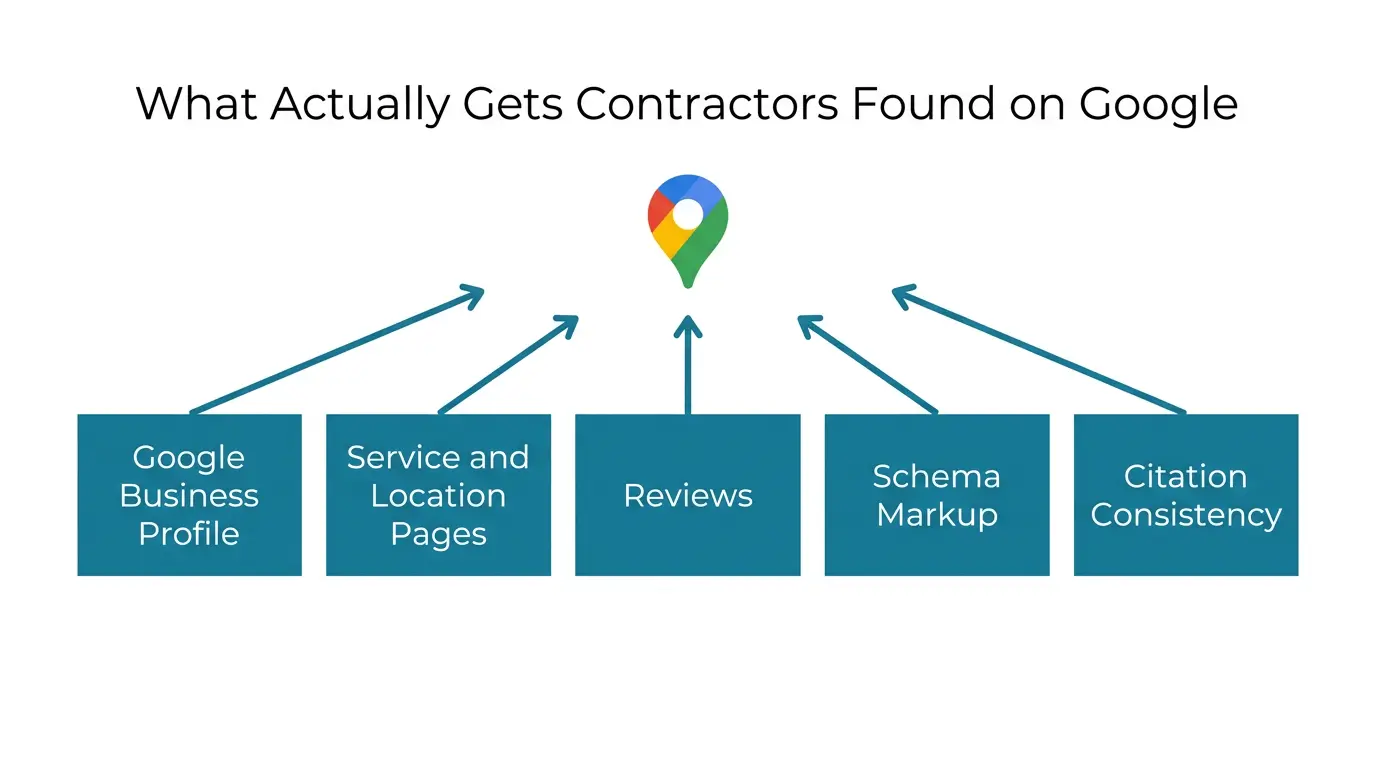
- A complete Google Business Profile. The most important factor for local search visibility. Fill out every field. Add real photos. List your actual services. Update it regularly. Most small businesses set it up once and never touch it again.
- Separate pages for each main service. One generic services page is not enough. A painting company needs pages for interior painting, exterior painting, cabinet painting, and commercial work. Each page targets a different search query and a different user.
- Real information on each page. Your service area, licensing, years in business, and photos from actual jobs. The specific details that tell a potential customer they are looking at a real local business.
- Schema markup on key pages. Schema helps search engines understand your content in a machine-readable way. It makes pages eligible for rich results. Use a WordPress schema plugin or work with a developer to implement it.
- Reviews, consistently. Google treats reviews as a trust signal for local search. Ask every satisfied customer. Respond to every review. Most businesses are not consistent about this.
- Brand mentions and citations that match. Your business name, address, and phone number need to be consistent across all directories. Inconsistent citations weaken local authority with search engines.
- Blog posts that target your local areas and are written with real search intent. For example, write about a specific question your target audience is asking, not a general topic. One focused post that answers a real question outperforms five vague articles every time.
AI search is also changing how homeowners find and shortlist contractors. See How AI Search Will Impact Contractors in 2026 for what is shifting and how to stay visible.
How to Use ChatGPT for SEO Without Wasting Your Time
Here is a workflow that produces content worth publishing:
- Write down what you know first. Your real pricing range. Your typical timeline. What customers need before you start. What goes wrong when someone hires the cheapest option. Even rough bullet points. This is the information AI does not have.
- Give AI your notes and ask it to write a draft. You are not asking it to invent content. You are asking it to help you express what you already know.
- Read it as a customer would. Does it answer the real question someone in your area is trying to figure out? Does it mention your city, your services, a specific detail that would make someone call you? If not, add those things yourself.
- Cut anything generic. If a sentence could appear on any competitor site unchanged, delete it or replace it with something specific to your business.
- Check the technical basics. Is your phone number and address consistent with your Google Business Profile? Does the page load on mobile? Have you added schema markup?
Use AI to go faster. Use your own knowledge to make it worth reading. You need both.
The Point on ChatGPT and SEO
ChatGPT can do parts of SEO. Drafts, outlines, blog post ideas, meta descriptions, and content structure. Those are real contributions.
It cannot do local SEO on its own. It does not know your market, your customers, or your competition. It cannot fix technical issues, align your Google Business Profile, add schema markup, or build a multi-city site structure.
Publishing generic AI content at scale can work against you in Google search results.
The contractors getting found right now are using every tool available, including AI, while making sure what they publish actually represents their business. That part still requires a human.
At Bold Peak, AI helps us move faster. Our knowledge of local SEO, site structure, and search engine best practices is what makes the content perform.
Not sure where your site stands? Get a free local SEO review from Bold Peak.
boldpeakllc.com | (978) 910-1522 | No sales script. Just clarity.
Frequently Asked Questions
Will Google penalize me for using AI content?
Not automatically. Google evaluates content based on whether it helps the user, not how it was produced. The problem is low-value, generic content. That can hurt your search results whether a human or AI wrote it.
Can ChatGPT do SEO for a local service business?
It can assist with specific tasks: drafting, outlining, and rewriting. It cannot handle local keyword research, Google Business Profile optimization, schema markup, site structure, or citation alignment. Those are the factors that actually move local rankings.
Do I need a blog to rank locally?
Not necessarily. A well-built service page often does more than ten thin blog posts. Get your core service and location pages right first. Blog posts support that over time, but are not the foundation.
What is schema markup and do I need it?
Schema markup is structured data that helps search engines understand your content. Google confirms it makes pages eligible for rich results and search features. For local businesses, adding LocalBusiness and Service schema to key pages is worth doing.
How long does local SEO take?
At Bold Peak, most contractors see early movement in 3 to 6 months. Consistent lead flow typically develops over 6 to 12 months. SEO is cumulative. Structure and alignment come first, then momentum builds.
What should I do first if I am starting from zero?
Build your website with specific pages for your main services and service locations. Then claim and complete your Google Business Profile. That alone puts you ahead of many local competitors. If you need more information on how to align your GBP with your website, see our GBP optimization service.
Where can I get help with local SEO?
Bold Peak LLC works with contractors in Massachusetts, New Hampshire, and nationwide. We build structured local SEO systems, not generic marketing. Visit boldpeakllc.com or call (978) 910-1522.
Sources
Google Search Central. “Using Generative AI Content.”
Google Search Central Blog. “Google Search and AI Content.”
Google Search Central. “Creating Helpful, Reliable, People-First Content.”
Google Search Central. “AI Features and Your Website.”
Google Search Central Blog. “Succeeding in AI Search.”