
TL;DR:
- Local SEO: making your contracting business visible in Google for nearby searches
- Core pieces: Google Business Profile, service area pages, consistent citations, reviews
- Results take 3–6 months but compound into a steady lead engine
- This guide breaks down each piece for home service contractors
Most contractors I talk to built their business the same way. Word of mouth. A referral here, a yard sign there, maybe a friend of a friend who needed a roof done. And honestly? That works for a while. But there’s a ceiling. At some point the referrals slow down. A competitor you’ve never heard of starts showing up every time someone in your area searches for what you do. Your phone isn’t ringing the way it used to. And you’re not sure why. That’s usually where local SEO enters the picture. This guide walks you through what local SEO services are, what they actually include, and why they matter for home service contractors specifically.
What Are Local SEO Services?
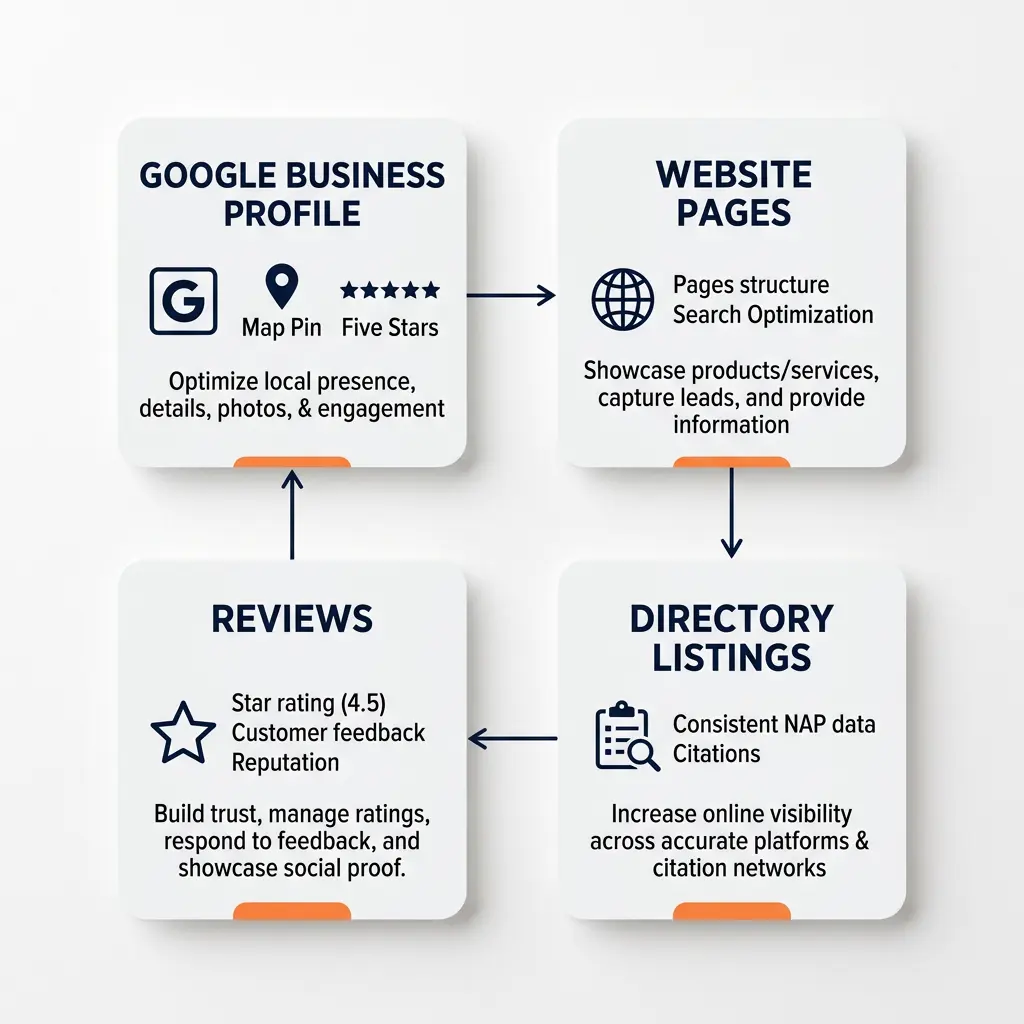
Local SEO services are a mix of strategies that help your contracting business show up in Google when nearby customers search for what you offer. The package typically includes optimizing your Google Business Profile, building location‑specific website pages, cleaning up directory listings, and managing your reviews. Done right, it connects all those signals so Google sees you as the obvious answer for local searches.
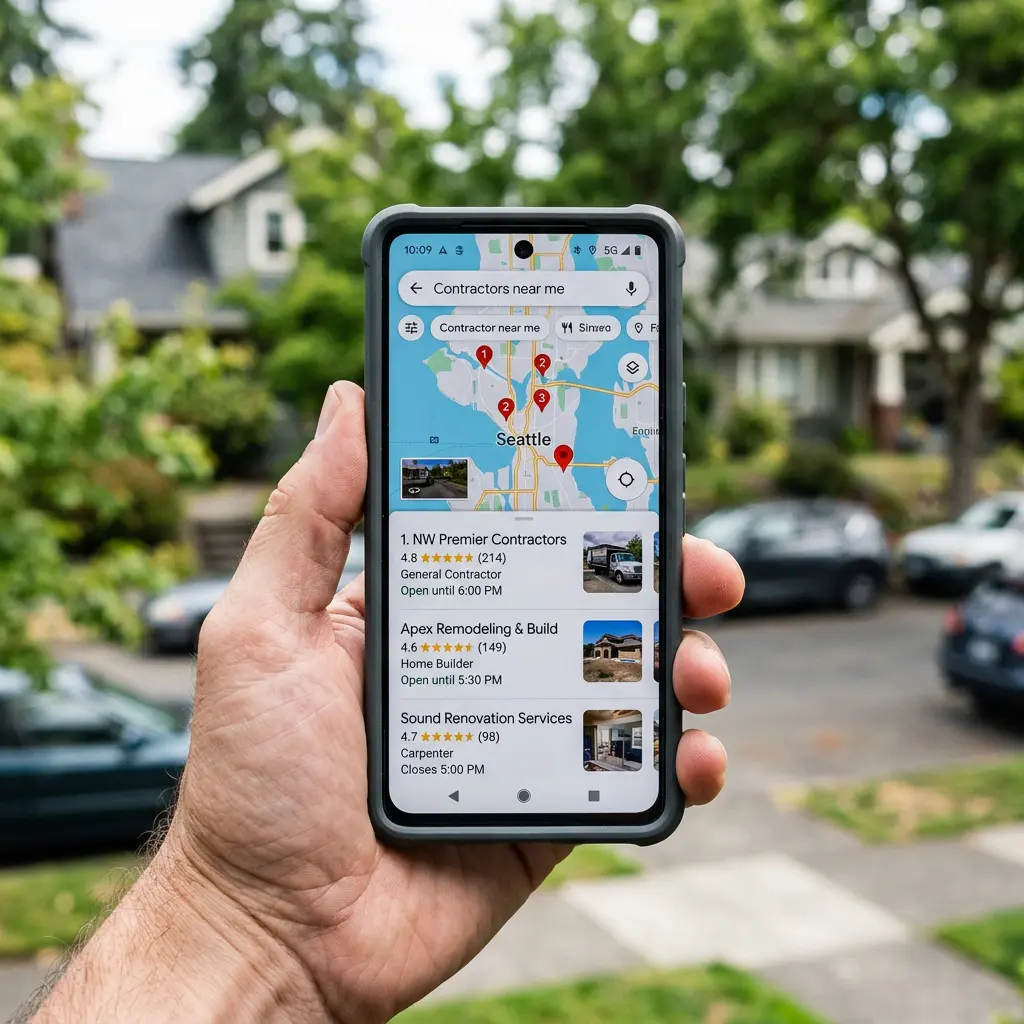
You’ve probably seen this in action without realizing it. Search “HVAC contractor near me” and you’ll notice a map at the top of the results with three businesses listed. That’s called the local 3‑pack. The contractors in those spots didn’t get there by accident. They built a clear, consistent online presence that tells Google exactly who they are, what they do, and where they work. So what are local SEO services in practice? The work ties together your Google Business Profile, your website structure, your directory listings, your reviews, and how your business appears across the web. When those pieces are aligned, Google can confidently recommend your business to people searching in your area.
What is local SEO services compared to regular SEO? Here’s a simple way to think about it. Regular SEO is about reaching as wide an audience as possible across the internet. Local SEO is the opposite: it’s narrow on purpose. It’s built around your city, your service area, and the customers who are close enough to actually book a job with you. A general contractor in Lowell, MA has no use for national traffic. What matters is showing up when someone in Lowell searches for a general contractor this week. SEO for local services is really about being visible to the right people at the right moment: not everyone on the internet, just the ones in your backyard who are ready to hire. For a deeper look at the basics, Moz offers an excellent explainer on what local SEO is and how it works.
Why Local SEO Matters for Home Service Contractors
Your next customer is almost certainly searching for a contractor online right now. Local SEO determines whether your business shows up at that moment. When your profile and pages are optimized, you capture highly motivated leads, the kind that often call and book within 24 hours. That immediate, geographically targeted visibility is what turns online searches into real‑world jobs.
Here’s something worth sitting with for a moment. BrightLocal’s latest Local Consumer Review Survey found that 80% of US consumers search online for local businesses every week. Nearly a third do it every single day. That’s not a trend that’s coming. It’s already here. What’s even more useful for contractors is what happens after that search. According to Google’s own consumer insights, 76% of people who search on their smartphone for something nearby visit a business within a day. Think about that. Someone searches for a plumber on their phone, and within a day they’ve called and booked. That window is exactly where local SEO earns its keep.
And your Google Business Profile plays a bigger role in all of this than most contractors give it credit for. Google has reported that businesses with complete, verified profiles are far more likely to attract customer actions: profiles with photos get 42% more requests for driving directions and 35% more clicks through to their websites. Most contractor profiles I look at are incomplete. Wrong categories. No photos. Service areas left blank. That’s visibility left on the table every single day. If your business isn’t showing up when people search, someone else is getting those calls.
What’s Actually Included in Local SEO Services?
A complete local SEO program works by bringing together several connected tasks: optimizing your Google Business Profile, building service‑area‑specific pages on your website, making sure your name, address, and phone number appear consistently across the web, and managing customer reviews. Every piece reinforces the others, and skipping one weakens the whole effort.
This is where a lot of contractors get lost. “Local SEO” sounds like one thing, but it’s really a collection of connected tasks that all work together. Miss one and the others don’t work as well. Here’s what a well‑structured program should cover.
Google Business Profile Optimization
Before most customers ever land on your website, they see your Google Business Profile. It’s the card that shows up in Maps, in the local 3‑pack, and increasingly in Google’s AI‑generated search answers. It’s often the first impression your business makes. A profile that’s fully built out includes your business name, address, phone number, service categories, the towns you cover, your hours, photos from real jobs, and regular posts or updates. That last part matters more than people think. An active profile signals to Google that your business is real and open. BrightLocal’s Local Marketing Industry Survey found that 76% of marketers consider Google Business Profile management the single most valuable part of a local SEO program. In my own work with contractors, it’s usually the first thing I fix, and often the one that moves the needle fastest. You can follow Google’s own guidance on how to keep your Business Profile complete and accurate.
Google’s AI‑generated answers are also pulling more from GBP data than before. A recent piece on how Google’s AI overviews are changing local SEO explains why keeping your profile up‑to‑date matters now more than ever.
On-Page SEO and Service Area Pages
Your website needs to speak Google’s language. That means structuring your pages so it’s obvious what you do and where you do it. One of the most common issues I see is contractors with a single “Services” page that lists everything they offer in one place. That page tries to rank for everything and usually ranks for nothing. What works better is having a dedicated page for each service in each city you cover. An electrician serving five towns needs pages built around each of those towns, not one generic page that mentions them all in a list. Moz’s guide on creating effective local landing pages breaks down why specificity wins. Google needs clear signals that connect your business to a place and a service. A roofer with a page built around “Roof Replacement in Manchester, NH” has a far better shot at ranking for that search than one without it.
Mobile speed matters too. Most local searches happen on a smartphone, and Google’s emphasis on mobile performance continues to tighten. A site that loads slowly or is awkward to navigate on a phone loses leads before you ever know they were there. Regular technical maintenance keeps that foundation solid.
Local Citations and Directory Listings
A citation is how your business appears across the web beyond your own site. Every time your name, address, and phone number show up on a directory, review platform, or local listing site, that’s a citation. Yelp, Angie’s List, HomeAdvisor, the Better Business Bureau, local chamber sites, and dozens of others all count. Google cross‑references this information to confirm your business is legitimate. If your address is listed differently across ten different sites, or your old phone number is still showing up on half of them, that inconsistency works against you. BrightLocal’s research consistently shows that consistent citations are a foundational trust signal for local search rankings. A clean, accurate citation profile across the web tells Google and your customers exactly where to find you.
Review Management
Reviews are another big piece. They influence both your rankings and whether someone clicks your listing over a competitor’s. Responding to reviews (positive and negative) shows engagement and can improve your conversion rate. When your whole local SEO program is active, reviews become a natural part of the flywheel: more visibility brings more customers, and more customers leave more reviews that strengthen your visibility.
How Long Does Local SEO Take to Show Results?

For most home service contractors, meaningful movement takes 3 to 6 months. Factors like your current online standing, market competition, and the consistency of the work all shift that timeline. The visibility you build compounds over time, strengthening your presence across every city you serve.
This isn’t an overnight fix. The first few weeks often focus on fixing foundational problems: getting your GBP claimed and verified, correcting inconsistent citations, and filling in missing on‑page signals. Once those basics are in place, you start to see gradual improvements in rankings and call volume. The real payoff is the cumulative effect. A contractor who stays consistent with local SEO for a year isn’t just showing up for one term in one town; they’re building a reliable lead‑generation engine that works across their entire service area, month after month.
Frequently Asked Questions
How much do local SEO services typically cost for a small contracting business?
Costs vary widely based on the scope of work and your market. Basic monthly packages that include GBP optimization, citation cleanup, and a few location pages can start around $500 to $1,000 per month. More comprehensive programs that add regular content creation, advanced reporting, and review management can run $1,500 to $3,000 or more. Many agencies also offer one‑time setup projects at a lower price point.
Can I do local SEO myself, or do I need to hire someone?
Many contractors successfully handle the basics on their own, especially if they have the time to learn and maintain consistency. Claiming and verifying your GBP, adding accurate business info, posting occasional updates, and asking customers for reviews are all achievable DIY tasks. However, deeper technical work like building location pages, fixing citation errors at scale, or conducting a full competitive audit often requires expertise and tools. Whether you go solo or hire help depends on your available time and how quickly you need results.
What’s the difference between local SEO and running Google Ads?
Local SEO focuses on earning organic visibility in the map pack and local search results, which doesn’t cost you per click. It builds lasting presence over time. Google Ads (pay‑per‑click) places your ad at the top of results instantly, but you pay every time someone clicks. Many contractors use both: ads for immediate leads while local SEO builds the long‑term foundation. When your organic presence is strong, you can often rely less on paid traffic.
How do service area pages help if I work in multiple cities?
Service area pages give Google a clear signal about each location you serve. Instead of one generic “Service Area” page that lists ten towns, a dedicated page for each city with tailored content, testimonials from that area, and location‑specific details makes it far easier for Google to show you when someone searches in that specific town. This structure effectively multiplies your chances of appearing for “plumber in [City]” searches across your entire region.
Does social media activity impact my local SEO rankings?
Social signals aren’t a direct ranking factor for Google’s local algorithm, but an active social presence helps in other ways. It can drive traffic to your website, keep your brand visible in the community, and give you another channel for collecting reviews and engaging with customers. A complete online footprint, including social profiles that link back to your site and match your business info, supports the broader consistency that local SEO depends on.